Coinbase is the most trusted cryptocurrency exchange in the world, providing a secure platform to buy, sell, trade, store, and stake digital assets. As the only publicly traded crypto exchange in the United States, they set the standard for transparency, reliability, and regulatory compliance in the industry.
My role
As a Senior Product Designer on the Platform team at Coinbase, I led the end-to-end design of core experiences that help users access, navigate, and manage multiple products across the Coinbase ecosystem. I focused on the Identity pillar, designing secure and scalable systems for authentication, account recovery, and multi-product access.
In addition to product design, I played a key role in scaling Coinbase’s design system, enabling consistent, accessible, and high-quality experiences across a growing suite of products. I collaborated closely with engineers and other designers to build new components, document usage patterns, and streamline cross-product workflows, significantly increasing design and development efficiency across teams.
I drove design strategy and execution through systems thinking, strong design craft, and cross-functional partnership, ensuring that every experience we ship is grounded in user needs, while aligning with company-wide platform goals.
Scope
June 2021 - July 2022: Platform • Regulatory (Retail product)
Onboarding (US & EU)
KYC Refresh
Big bet project
ID Verification
Remediation
July 2022 - Dec 2024: Platform • Identity (Cross product)
Security
Accounts Management and Settings
Multi Factor Authentication & Registration
Account Recovery
Multi-product navigation components
Session Switching
Risk flows
Unified Sign up and Sign in
Multi-organization vision
Identity service product library
Unified Access across Coinbase
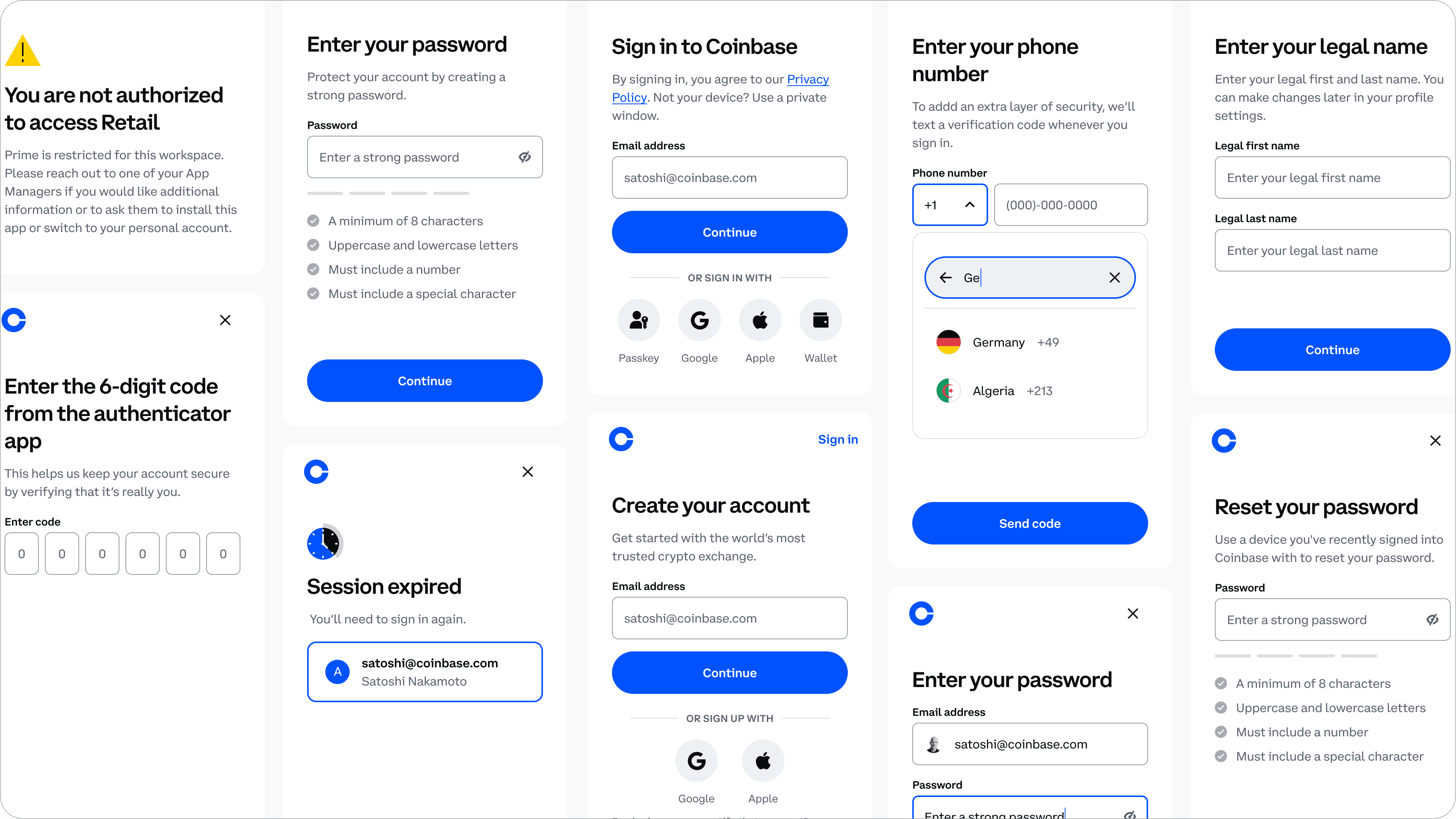
I led the end to end design of Unified Registration, from discovery through delivery, partnering with Identity PMs, legal and compliance leads, engineers, researchers, CX, and teams across Consumer, Institutional, and Developer.
The goal was to create a unified, scalable, and compliant registration experience. We replaced fragmented product sign ups with a single streamlined flow where users register once to access the entire Coinbase ecosystem.
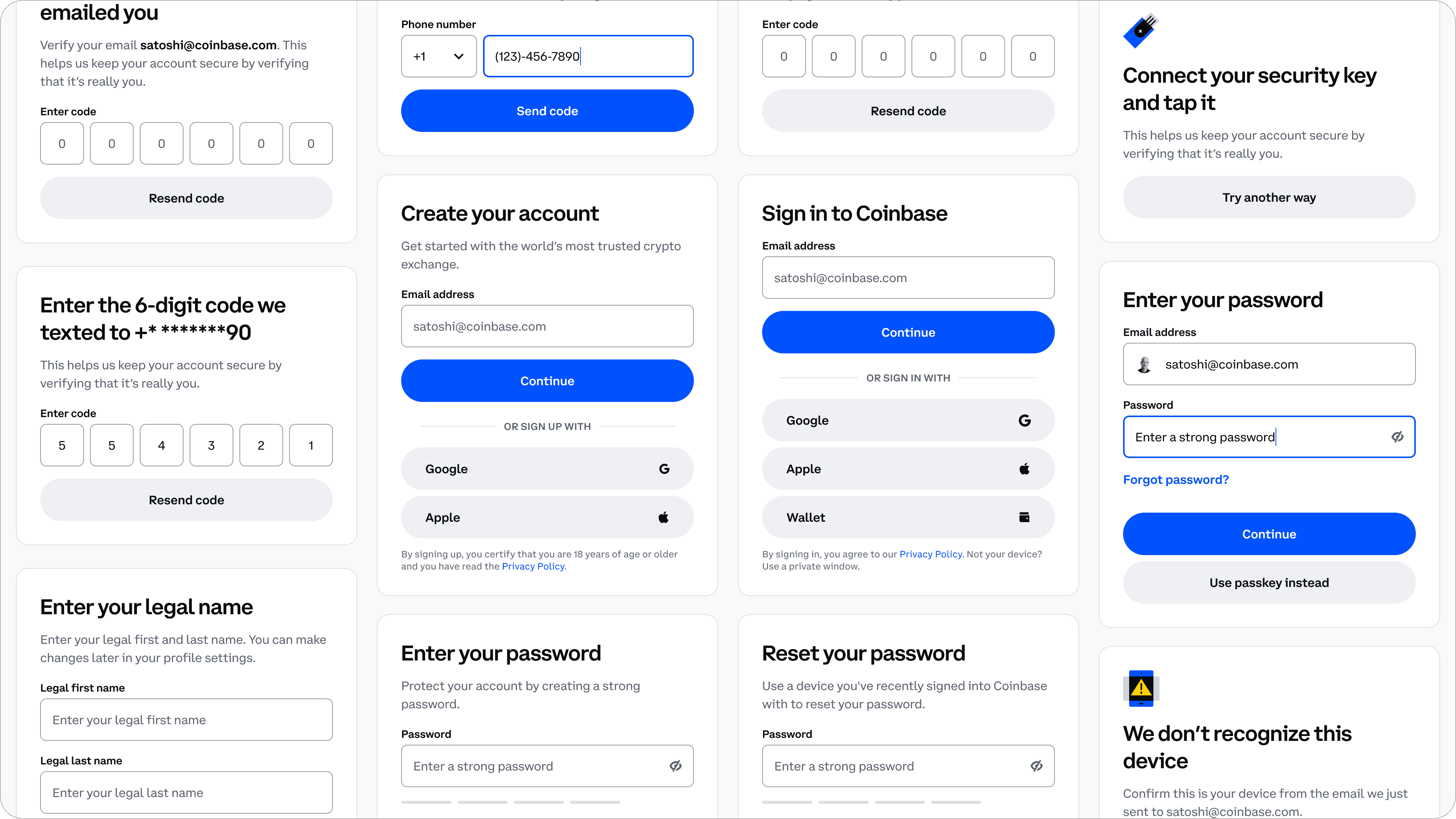
From Coinbase.com, users first select their user type. They then move through core steps—sign up with email or a third party option, verify email, create a password, and confirm their phone number. Based on the user type chosen at the start, the system introduces the right compliance requirements, ensuring a tailored and regulation aligned experience while keeping the flow cohesive and scalable across products.
Regulatory alignment in onboarding
I led the design of Coinbase’s identity verification (IDV) system, collaborating with external vendors whose technical and compliance constraints directly shaped the design and user experience. Drawing on my background in the Regulatory team, I applied deep knowledge of legal frameworks and audit requirements to ensure the system met strict regulatory standards.
The result was a verification system that was not only secure but also usable, extensible, and durable across Coinbase’s entire ecosystem. This work improved compliance alignment globally, increased document verification pass rates in key regions, and reduced support tickets tied to onboarding. By building for both scale and adaptability, we created a foundation that continues to support evolving regulations and new product growth.
Login
At Coinbase, I led the unification of fragmented sign up and login flows into one cohesive system. Previously, each product had its own onboarding and authentication, which confused users, created the perception of separate accounts, and increased drop off. By testing patterns, aligning with accessibility and design system updates, and co creating an Onboarding Component Library, I built scalable foundations that adapted to local KYC rules, document types, and languages. This accelerated rollout to new regions and reduced onboarding support tickets.
Working with the Design Systems team, I created the Multi Content Module, a flexible container for all registration types. This single component scaled across sign up and login, accelerating adoption across products and improving the quality of all identity experiences. Extending the system to authentication, we unified login so that users now sign in once to access every Coinbase product through a consistent and secure flow. This reduced login related confusion and cut repeated authentication attempts.
The result was a shift from many disconnected entry points to one unified registration and login system that was accessible, compliant, and scalable. The work improved usability, increased verification pass rates in key markets, reduced drop off during onboarding, and enabled Coinbase to operate as a cohesive ecosystem rather than siloed products.
Settings
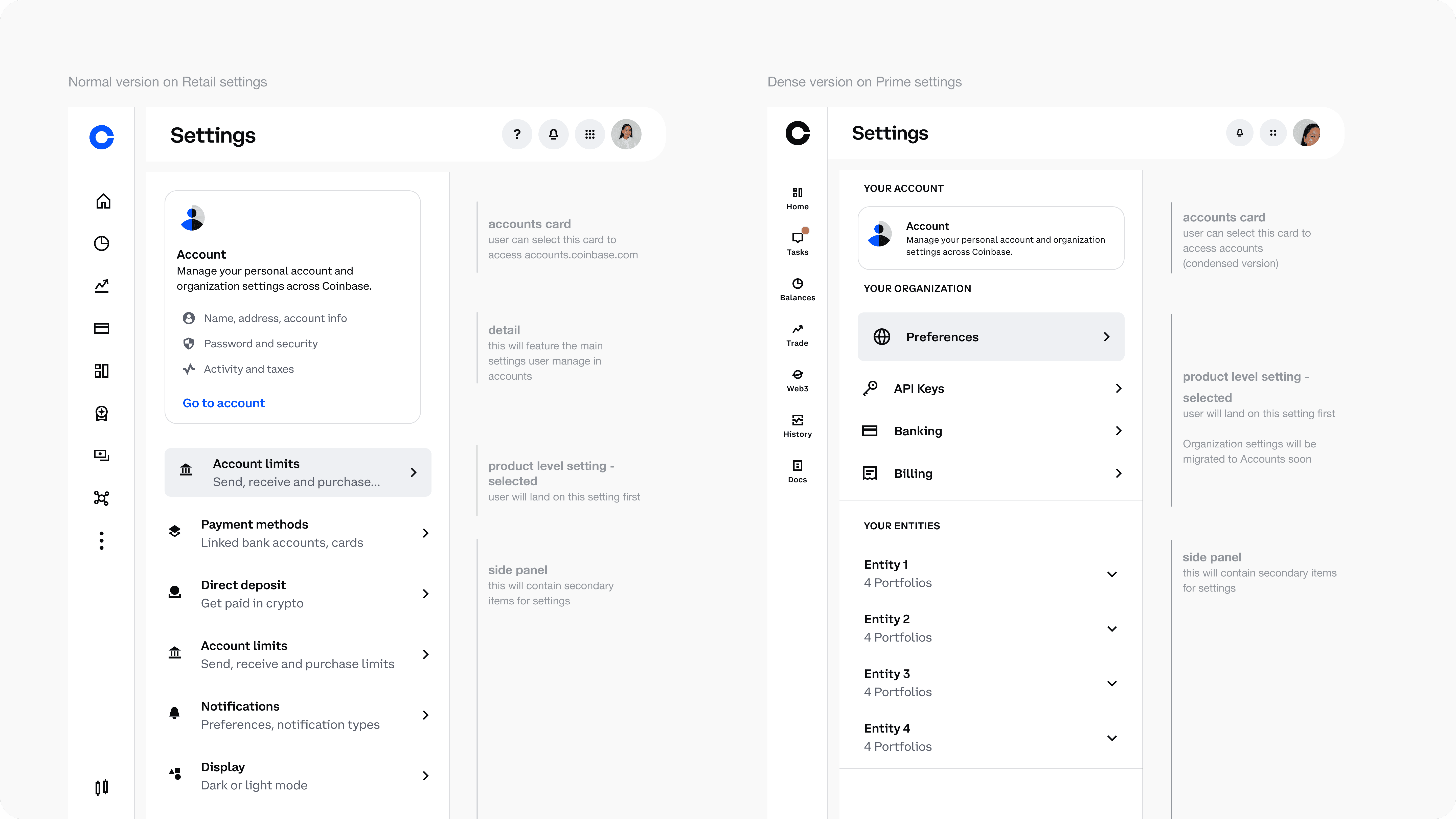
At Coinbase, I led the redesign of how users navigate and manage their account settings, security, and authentication across the entire ecosystem. Previously, settings were fragmented across products, making it difficult for users to find what they needed. Account level and product specific settings were mixed together, security controls were buried, and the inconsistency drove confusion and a high volume of CX tickets.
As the designer on the Platform team, I drove the end to end design strategy and execution. I facilitated cross org workshops to define a scalable settings architecture, partnered with Consumer, Institutional, Developer, and Infrastructure teams, and ultimately designed accounts.coinbase.com as the single hub for all account level settings.
The result was a unified, platform wide system that simplified navigation, centralized account management, and created a clear distinction between account level and product specific settings. This improved usability, strengthened security, reduced support requests, and established a scalable foundation for all future Coinbase products.
Navigation
Coinbase’s navigation was fragmented: users were logged out when switching products, and inconsistent patterns eroded trust. I partnered with the Design Systems team to create standardized navigation components, re-architecting the logged-in navigation bar, profile menu, and app switcher into a scalable system.
By consolidating specs, centralizing infrastructure, and collaborating on documentation, we enabled adoption across teams and streamlined discoverability. The result was a cohesive navigation system that unified the platform and made switching between products seamless.
Impact
User success (reduced drop-off, increased completion rates)
Business impact (more verified users, more product activations, higher retention)
Compliance alignment (audit pass rates, reduced legal risk)
Operational efficiency (fewer CX tickets, lower eng maintenance, faster rollout to regions/products)
Reduced onboarding drop-off, increased registrations across products, and established a system adopted by 100% of Coinbase products for login and sign up.
Improved pass rates in key regions, reduced retries, and lowered compliance-driven friction while meeting regulatory requirements.
Consolidation of settings into accounts.coinbase.com reduced confusion, cut CX tickets, and increased adoption of security features like 2FA and passkeys.
Standardizing navigation cut re-login pain points, increased cross-product usage, and drove design system adoption across Consumer, Institutional, and Developer teams.
Reflection
In my 3.5 years at Coinbase, I learned that collaboration is the foundation of impactful work. The most meaningful projects I led: unifying registration and login, scaling identity verification, centralizing account settings, and standardizing navigation, were only possible because of deep partnerships across PMs, engineers, legal, compliance, CX, and Design Systems.
Through these experiences, I saw firsthand how design can unify fragmented systems into cohesive, scalable foundations. By aligning cross functional teams, I helped reduce drop off in onboarding, increase verification pass rates, cut CX tickets, and strengthen trust across the entire ecosystem.
Ultimately, the biggest takeaway was that great design is not just about the interface, but about building systems and aligning people to create clarity, trust, and scale across products.